


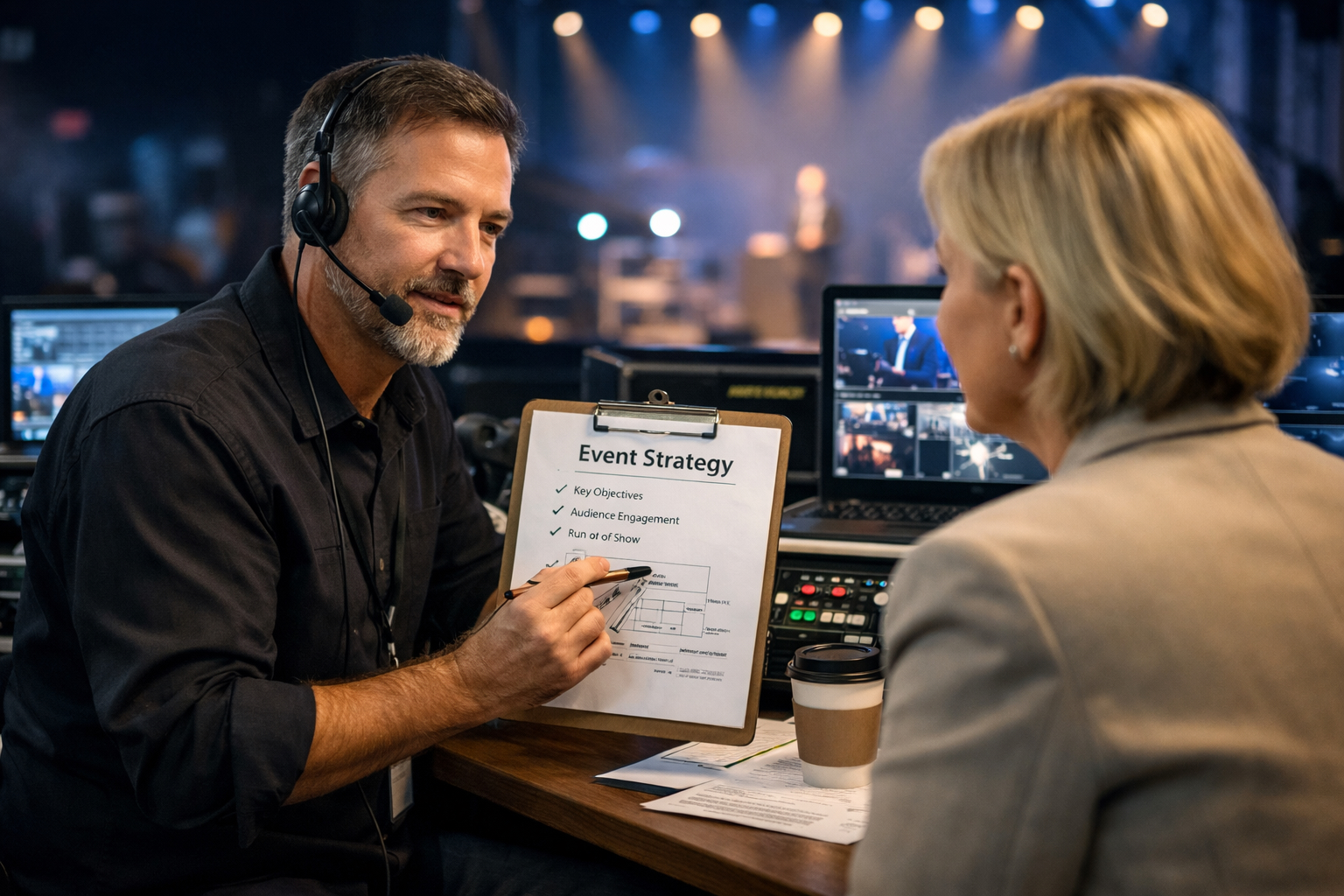
In live events, scale is often mistaken for sophistication.
Bigger LED walls. Larger crews. Expansive scenic builds. More screens, more cues, more complexity.
But experienced event leaders understand something critical: scale does not automatically create impact.
Strategy does.
In today’s environment—where stakeholders demand measurable ROI, audiences expect thoughtful experiences, and budgets face greater scrutiny—production must serve a clear business objective. Without that foundation, even the most visually impressive event can feel disjointed.
And disjointed events don’t drive results.
The Shift from “More” to “Meaningful”
There was a time when production value was judged by visible complexity. If the stage was large and the lighting package extensive, the event was considered elevated.
That thinking no longer holds.
Today’s audiences are sophisticated. They can sense when production supports a purpose—and when it exists simply to impress.
Modern event production is about intentional design. Every lighting cue, camera shot, scenic element, and audio configuration should reinforce the core message.
Before increasing scale, event leaders should ask:
- What business outcome are we trying to influence?
- What key moments require emphasis?
- What emotional journey should the audience experience?
- Where does production clarify the message—and where might it distract?
When production strategy leads decision-making, clarity follows. Resources are deployed where they matter most. The result is an event that feels cohesive, focused, and deliberate.
Strategy Aligns Production with Business Objectives
Professional AV production is not decorative—it’s functional.
Whether hosting a sales kickoff, leadership summit, investor meeting, or product launch, production should actively support defined objectives such as:
- Reinforcing brand positioning
- Driving revenue alignment
- Increasing internal engagement
- Strengthening partner relationships
- Launching strategic initiatives
For example:
A product launch benefits from tightly controlled lighting, revealing moments that build anticipation.
A leadership summit requires pristine audio intelligibility and clean sightlines to reinforce authority.
A training event depends on visual clarity and pacing to improve retention.
When production is aligned with business strategy, it becomes a performance tool rather than a background element.
Without alignment, even substantial investment can fall flat.
Efficiency Is a Competitive Advantage
Overproduction often stems from uncertainty. When goals are unclear, teams compensate with scale.
But more equipment does not equal more effectiveness.
Unnecessary complexity introduces:
- Higher labor costs
- Longer load-in schedules
- Increased technical risk
- Budget strain in non-essential areas
Strategic production evaluates necessity before expansion.
It asks:
- Does this element strengthen the audience experience?
- Does it serve the message?
- Does it justify its cost?
In many cases, a thoughtfully designed stage with intentional lighting and well-balanced audio outperforms an oversized setup.
Clients recognize this difference. An event that feels clean and confident signals professionalism. An event overloaded with elements can signal excess rather than excellence.
Technology Should Support Storytelling
Emerging technologies—from AI-powered visuals to immersive LED environments—offer powerful capabilities. But technology must serve narrative, not overshadow it.
The most successful events use technology to:
- Reinforce key messaging visually
- Create seamless transitions between segments
- Improve audience immersion
- Support hybrid engagement
Strategic AV partners prioritize clarity and cohesion. They do not add tools simply to appear innovative. They evaluate whether each technical component advances the event’s purpose.
This disciplined approach ensures production enhances storytelling rather than competes with it.
The Hidden Risks of Overproduction
More moving parts create more opportunities for error.
Complex cue stacks increase rehearsal demands. Oversized scenic elements require longer load-in windows. Excessive technical layers introduce failure points.
Strategic production reduces vulnerability.
By simplifying where possible and strengthening where necessary, experienced production teams create environments that are both impactful and reliable.
Reliability may not be the most visible attribute of an event—but it is one of the most valuable. Technical stability protects the brand, the message, and the overall investment.
Collaboration Drives Strategic Clarity
An effective production strategy begins long before load-in.
It begins with collaborative planning.
When AV partners are engaged early, they contribute insight into venue constraints, technical efficiencies, budget optimization, and creative opportunities.
Strong collaboration includes:
- Discovery conversations centered on goals
- Site visits to assess environmental factors
- Transparent budget alignment
- Clear run-of-show planning
- Realistic timeline mapping
This proactive approach prevents reactive decision-making. It ensures production supports the broader event strategy instead of scrambling to accommodate late changes.
(Internal link suggestion: Behind the Scenes: How to Pick a Reliable AV Partner for Your Event)
What Strategic Production Looks Like in Practice
Strategic production often includes:
- Stage layouts designed for audience focus
- Lighting that guides attention rather than overwhelms
- Audio systems engineered for clarity and coverage
- Seamless content transitions that protect pacing
- Scenic elements aligned with brand standards
It feels effortless to attendees.
But that simplicity is the result of disciplined planning.
The goal is not spectacle for its own sake. The goal is precision.
Long-Term Business Impact
Events influence perception long after they conclude.
A thoughtfully produced leadership summit can strengthen internal confidence.
A precise product launch can accelerate buyer trust.
A well-executed conference can position a company as an industry authority.
These outcomes are not accidental. They are the product of intentional alignment between production and purpose.
When strategy leads, scale becomes a tool—not a distraction.
Let’s Design with Purpose
If you’re planning an event and want production decisions aligned with business outcomes—not just equipment lists—let’s start the conversation.


